
11th to 20th October, 2019
Our journey through Serbia had three aims: perhaps four. Monastries, Roman sites and British war time experiences with Tito. The fourth was to see if Serbia would interest the friends of Reality & Beyond. It was successful on all fronts.
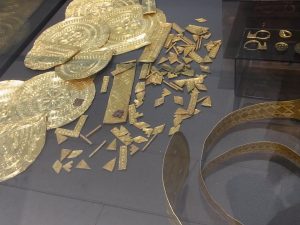
Gold from Nove Pazar
Belgrade on the confluence of the Sava and the Danube is, at its heart, attractive and buzzy. Far distant from its description as the gangster city, its profile in the early 90s in the terrible civil war. From our hotel in the old town most was within walking distance, the National Museum, the Enthnographical Museum, cafes and the castle. The Old Town does not allow traffic, at least in theory, and gates close definitely to cars at 18.00. The National Museum is 5 minutes walk, it is worth two visits. At ground level archeology and coinage, including the gold found in Nove Pazar, and the Mesolithic heads from Lepenski Vir are a wow by world standards. There is also a fine and telling portrait head of Trajan, he of the Iron Gates fame. The first floor is a must if Serbia is to make sense: Serbia’s history of invasion, Nation State and the Orthodox Church. Didactic perhaps, but with exceptionally good maps and labels. The top floor has European collections and Yugoslav. It is useful to be reminded of the links with the frescos from Serbia’s great churches (including those now in Kosovo)and Quattrocentro Italy via Byzantium. Surprisingly for the Balkans, the 20th century gallery was a joy. Seek out Zenitism, a Serbian/Croatian mix of Futurism and Abstraction.
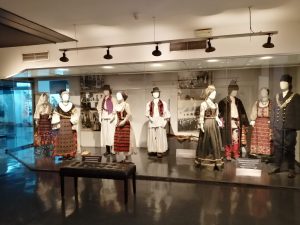
In the ethnographic museum
The Enthnographic Museum has wonderful costumes revealing background, age, marital status and district. It is beautifully laid out. How telling costume is. The mere tying of a scarf reveals country. This was illustrated via some miniscule war photos showing that, unknown to her, my companion’s father had been in Bosnia and not just in Serbia.
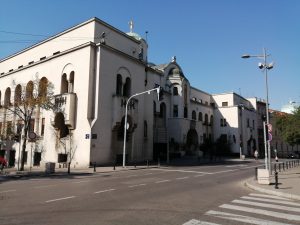
Patriarchate
Within a few minutes walk is the Patriarchate, a good building of the 1930s and Cathedral of the Serbian Orthodox church and Princess Ljubica’s house. We lunched at a kafana. Kafanas are more than cafes and recommended eateries throughout the country. Then to the castle with our guide, Ivana Dimic, renowned Serbian writer and playwright. She summed the castle up as ‘what you see outside you see inside’. This is true of so many. However from the lower fortifications the view of the rivers is unmissable.
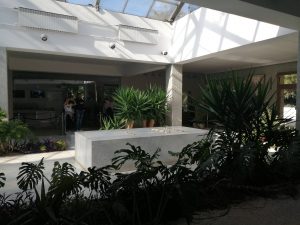
Tito’s tomb
Some find the House of Flowers, the whimsical title of Tito’s mausoleum, dull, including Ivana, but then her grandfather was murdered by the Communist leader after the war. It is revealing. As with an Egyptian Pharaoh and tomb furniture, Tito has a model of his train for foreign visits and entertaining grandees plus an obsessive collection of batons, as used in relays for youth sport. As with the SOKOL movement it was a sort of ‘healthy body equals a heathy mind’. All ended up with Tito plus blown up photos of visiting royalty, including the Queen. The adjoining museum is fun. The communist posters tell nothing new but Tito’s clothes do.
The journey back into the city went via Tito’s official residence which had also been the Royal Palace. Grand, in woods and in salubrious suburbs. Visitors must book in advance in Belgrade city.
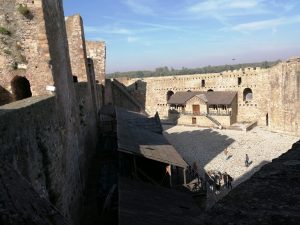
The chapel of palace relics of St. Luke
Thanks to Paddy Leigh Fermor’s description of crossing from Romania into Serbia in Between the Woods and the Water, as on a pilgrimage, we followed the Danube as far as where the Iron Gates had been. The plaque by Trajan can only now be seen if you are in a boat. We were not, but the drive from Belgrade is wonderful taking in ancient capital, Smederevo – the inner castle was the palace of the Serb Despot, George Brancovic, and the last important building by the Serbian nobility before defeat by the Ottomans. The church, according to the local guide, held the relics of St. Luke until the Turks came. Well that was news. The outer walls were completed 9 years later. Some parts contain reused Roman stone from a building 10 kms away and in brick...
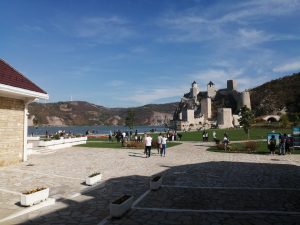
Golubac castle
The barges recall Leigh Fermor’s descriptions, the contents of which are unloaded into waiting trains. The picturesque Golubac is disneyfied. Best looked at from afar. We had delicious fish soup further down the river where they spoke Romanian. Might they have been Vlachs? The dam in 1970 caused flooding of the river valley and archeologists were working against time. The discovery and rescue of the remarkable Lepenski Vir. All the layers of this Mesolithic site (5000 BC) were raised and enclosed.the building of the enclosure was completed in 2011. There is a wonderful film of the dig. The archaeologist, Professor Srejovic made the finds of the century, surely, as he was involved too in Felix Romuliana.
Leaving our companions to return to Belgrade, four of us continued to Bor. All looks very socialist of the 60s with highrises built for the miners working the gold and copper. The mining was started in 1903 by the French until 1941 when Germany bought the mine which seems odd at that time. Why bother to buy when you were the victor in war? Now the Chinese have a 65% stake and the locals were not happy. We eat in a Kafana full of men and cigarette smoke. We tried the Kajmak, a sort of salty Devonshire cream. Lovely and fun on a Sunday evening.
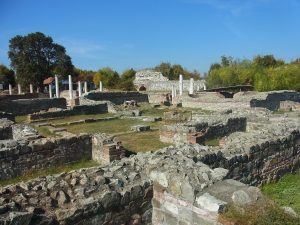
Felix Romuliana
From Bor the journey takes about 20 minutes to Zajecar which is was the spring board for the great fortified palace and mausolea of Felix Romuliana. Built by Emperor Galerius and his mother, who died in 311, and gave her name to the site. Romulia was Dacian and with him withdrew out of Dacia (Romania) across the Danube and the Iron Gates were demolished. The town hotel is a possibility and is near the outstanding museum which is uniquely open 7 days a week. The curator took us around the small but well designed display of the stunning mosaics and marbles from the site.
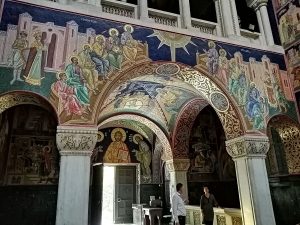
Mosaics made in Berlin
Looking down on the site are the mausolea to mother and son. This great palace, Anne Kindersley (AK), author of ‘The Mountains Of Serbia’, compared to Split. The beech forests were turning colour set against a blue sky. The perfect place for this filial apotheosis. They were the last Roman Gods. Then came along the Christian Constantine and spoilt it all.
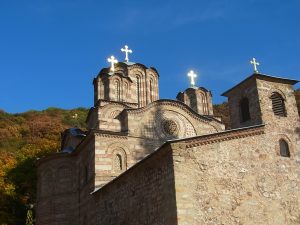
Ravanica
The monastery of Ravenica has parallels with Felix Romuliana although it is profoundly Christian. It is fortified and a burial site for one of the last Despots of Serbia. Lazar died at the battle of Kosovo in 1389 and he was buried in his foundation. His relics imbued with special powers. The battlefield was revisited by Milosovic to rouse the Serbs in 1989. Although the remaining frescoes are of high quality, the lasting memory is the exquisite stone work around the windows, thanks to mining wealth.
The architecture at Manasija is stark in comparison, built by Lazar’s son, Stephen, again as his mausoleum, but the frescoes make up with a monumentality along side defined courtly detail. It was the last religious foundation of the Serbian Middle Ages before the Ottoman conquest.
Enroute to the church we passed rusting Russian T55 tanks, relics of the the 60s ready for the scrap heap. This was in spite of Tito having broken with Soviet Russia in 1948.
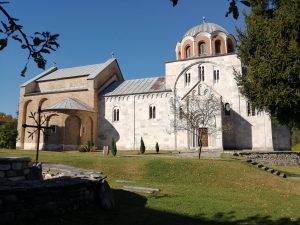
Studencia
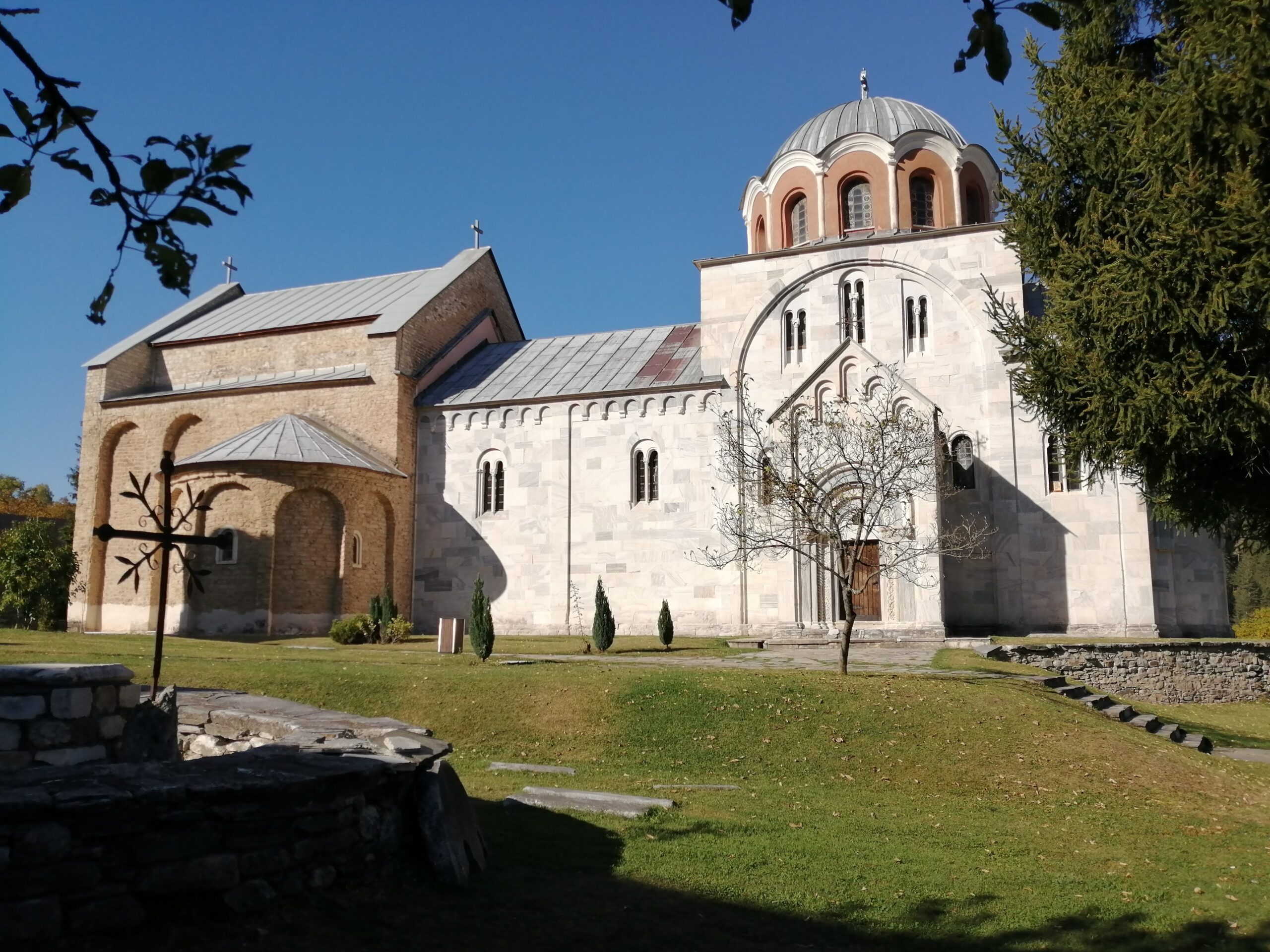
We stayed the night in Vrnjacka Banja and from there to the Monastry at Zica via the military base in Kraljevo. As a group the buildings are wonderful. On the road from Zica to Studencia we passed high above us, the castle of Maglic which the indefatable AK had visited by ferry. Suddenly we were in pine forests as we neared Studencia. The monastery narthex was filled with fine frescoes which AK describes beautifully, “The figures are dancing out of some Herculaneum dining room.” Where the Serbian artists soar above later Orthodox painters is that they take the late classical forms of Byzantium, Athos or Ohrid, and instill extraordinary vision of the sacred translated into human life. This is also true of frescoes found in Kosovo and Macedonia. The architecture too is a surprise. It is Italianate. The west entry is with its finely cut white marble façade, two chapels to north and south, and the remains of a Ciborium which could have been left by the Pisani.
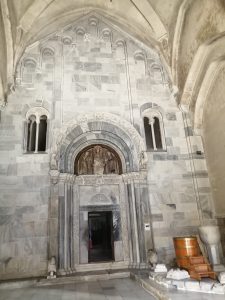
West door at Studencia
Restorers are removing an earlier restoration of the nave frescoes completing the original layer in a distinguishable way. It is extraordinary how after Ottoman treatment for centuries so much remains in all these great churches. We left at 4 and so arrived at Gradec at dusk. Huge damp course work going on outside this little monastic gothic church built by Helen of Anjou. There is a Catholic church nearby perhaps built for the workmen. Helen built in the Gothic style and with white marble although the candelabra are later – as Kotor. She became a nun and is buried there. There was an English mother superior here in the 1980s before the war started. It was a chapel Royal in these remote hills.
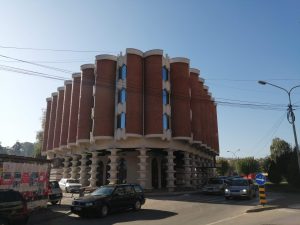
1960s hotel in Nove Pazar
In Nove Pazar the Moslem influence is evident; many of the women have covered their heads. The evening passagiata was buzzing with all ages involved, In the main street is one restaurant serving wine run by a Serbian family all the rest are dry. The town was ruined in the 60s and there is little sense of history. The Han, which has a huge dining area and bedrooms for 15 euros a night, is uninviting and seems typical of the town’s wish not to do anything with itself. Even the Sunni mosque is dull. We stayed in a spa out of town in a hotel that seemed totally the result of ill gotten gains, owned by a local family, and only finished a few months ago. They should have sacked the architect if there was one. An option would be staying at the Hotel Urbak in town described by Misha Glenny but the restoration looks slow. The market is good and the prunes from the black plums are stoneless and delicious. We bought raqui here too and a hot pepper…
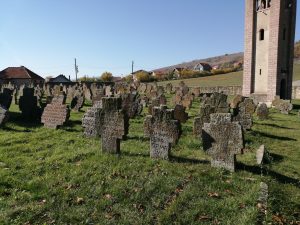
It is worth going out of the town to the tiny church of St Peter built over an earlier site where a great horde of early gold (5th century BC) had been wrapped up and laid in the foundation of the 12th century. The Gold is now in Belgrade. Most interesting are the grave stones and the baptistry in the shape of a four leaf clover. Here was a huge busload of Orthodox Serbs.
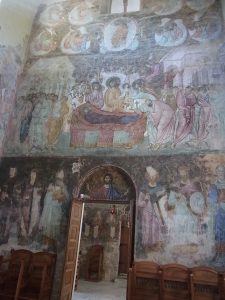
Dormition at Sopocani
The road to Sopocani was beautiful and like all our routes much smoother than the equivilant in the UK inspite of what people had said. The whole of both the complex and the frescoes were beyond expectation. The monastery will have a pensione next year. I had wanted to see this church for decades and its frescoes are among the most beautiful in the Balkans. AK describes it as difficult to leave. It is. It was too far to visit Mileseva which might be better seen from Monte Negro and so we reached Sirogojna at dark. It is a brave effort to create an outdoor museum of rural buildings. The meadows are filled with the cows, haystacks, goats, farmers sowing broadcast, etc but not old buildings… you can stay here. A bedroom with bathroom for 20 pounds is good value and spotlessly clean.

Market in Uzice
We continued to Uzice where Tito defeated the Germans and held them at bay for over 60 days in 1941. The town is unattractive and our accommodation was a wonderful case of hope over adversity. Hotel Surprise was just that, lovely apartment and charming owner who led us to the restaurant ‘My River’. Family run with delicious food and wine. A massive breakfast met us in the morning Borak with melted kajmak inside. And Turkish coffee and tea.
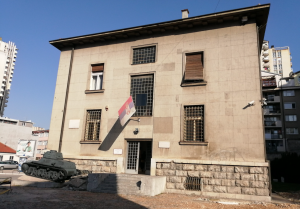
Tito’s museum
The Tito Museum was in one of two sturdy buildings planned for the Yugoslav National Bank in 1937. The bank was to be moved out of Belgrade in case of war. Tito’s room is furnished as that of a bank manager plus iron bedstead. The vaults of the bank were useful for making armaments, the sharing of which with the Chetniks was disputed leading to an early split. Which continued with devasting effect until the end of the war.
Turning north to Belgrade we picnicked in the grounds of the monastery of Vujan. The church held the monument to the grandfather of the Queen Draga of Yugoslavia who was assassinated with her husband the King, in 1903 ‘The May coup’. They were thrown over a balcony.
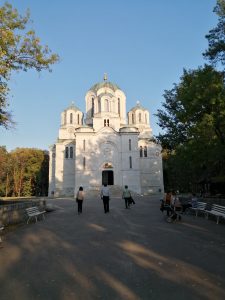
Topola
The Karadordevic kings wished to stamp their destiny on Yugoslavia. They did this in time-honoured fashion in building a church and mausoleum at Topola. The latest king to be buried there was King Peter in 2013.
The king himself, who was married to Queen Marie of Romania’s daughter, lived in the modest house nearby to watch progress. This was in 1912. The great church was begun around this time too. Its wonderful interior enriched by copies, in mosaic, of ‘highlights’ of the great church frescoes of Serbian Orthodoxy. You can find yourself taking part in a quiz of great Serbian church frescoes. The cartoons were made by Russians and the mosaics made in Berlin. There is heaps more room in the crypt.
Not by design but by following the most fascinating sites around Serbia whether it be Roman, medieval or modern, we discovered that Serbia offers buildings proclaiming wealth, invention and great beauty all intending to shore up the far from stable life of a ruler.