


JOHANN SCHAAS 1933-2023
Hans Schaas has died at home in Richis, his Reichesdorf, after a short illness. His wife, Hanne, was with him, so too were his family from Germany. Hans and Hanne refused to join the exodus of the Saxons to Germany in the early 90s.
Fittingly, he will spend the night before his funeral in the church he so loved. The path is already scythed up to the graveyard of the Saxons which overlooks the village where he was born and brought up.
He was a neighbour and friend. When I used to call out to Herr Schnapps he used to hush me but I noticed at his 90th birthday earlier this year, this nickname was referred to with fondness . His schnapps was exceeding good.
He was a countryman and farmer, walking with that characteristic springy step accompanied by his pet ram. As I write, his distinctive high-pitched tone of voice and rushed words coming out in spurts, laughing at his own jokes, is vivid.
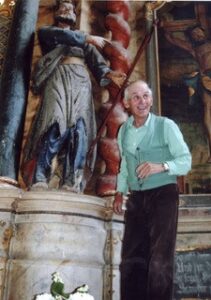
My earliest memories are of him guiding visitors around the church in Reichesdorf/Richis, famously pointing out the numerous ‘Green Men’. He found them everywhere in the church. He also enacted the strange sinners’ penance turning his fingers in the holes in the stone and most memorably prodding with a long stick he kept for the purpose, the painted and gessoed ‘skirt’ of John the Baptist with which a group of concerned ladies in the 1880s (including his own mother) had wrapped the Saint’s legs to avoid distraction. Memorably he jumped from chancel floor to altar in his younger days. I suppose in his 70s. I took the photo.
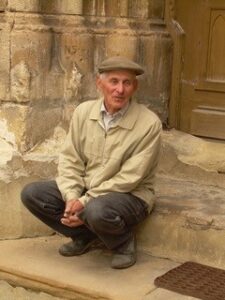
Hans Schaas talking to visitors outside the Saxon church; below, telling one of his favourite stories in the chancel
He, along with Sarah Dootz of Viscri, were interviewed about their autobiographies at the Transylvanian Book Festival in 2013. However, when I was writing the entry for Richis for the Blue Guide to the Tarnava Valley he refused to speak of the previous Saxon owners of the houses in Richis in the immediate Communist period after the war as the events were too violent and would just stir up old and bad memories.
He was a wheel wright by trade and when I was given a governess cart with one wheel he famously showed the journeymen and woman carpenters how the wheel was made out of three different wood and completed with an iron rim. It was the last wheel he made and certainly the last such wheel made in Richis.
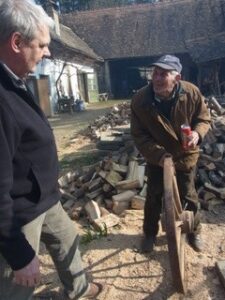
Hans Schaas telling architect Jan Hülsemann about his craft of wheelwrighting at Richis
He was a great and knowledgeable producer of wine and indeed he gave me the material for the wine chapter in the Blue Guide. He pointed out that the communists took all the wine the village famously made and they discouraged the growing of the ‘Royal Varieties’ for which Richis was famous. He remarked that the communists took the village wine but they could not take the earth . He wished for the industry that made the village so rich would re start. Let’s hope it does.
He would be pleased however, that the whitewash that was so assiduously applied by the villagers in the 1880s is about to be removed thanks to funding from the Mihai Eminescu Trust and the Horizon Foundation supported by the local village charity, Pro Richis. The Schaas family and their contemporaries lived through difficult times. However, they persevered, keeping the memories of these extraordinary Saxon communites alive. Last September, at the end of the book festival, he thanked the fine musicians. He was moved by the quality of the singing and the chamber music and delighted that his church was full once more.